
West Oahu Living Guide: Cost, Commute & Lifestyle
Ask anyone who's been house hunting on Oahu in the last decade where the growth is happening, and the answer is almost always the same: West Oahu. Once defined by sugarcane fields and a long drive from anywhere, the Kapolei-ʻEwa region has become one of the most active corners of the Hawaii real estate market, home to brand-new master-planned communities, Oahu's official "Second City," and some of the most attainable housing left on an island where space is scarce and demand never really lets up.
This guide covers the four communities that define West Oahu today: Kapolei, ʻEwa Beach, Hoʻopili, and Makakilo. Each section walks through location, lifestyle, dining and shopping, amenities, and real estate insight, so if you're moving to Oahu and weighing whether this side of the island is the right fit, you'll have a genuinely complete picture to work from.
Why West Oahu Is Reshaping the Island
West Oahu's transformation didn't happen by accident. In 1955, the Ewa Master Plan by the Estate of James Campbell first identified this stretch of former ranch and plantation land for long-term residential and commercial development, and in 1977 the City and County of Honolulu formally designated Kapolei as Oahu's "Secondary Urban Center", a deliberate plan to relieve overcrowding in town while giving West Oahu its own self-sufficient hub. Decades later, that plan has largely delivered: this region now has its own shopping malls, hospital, university campus, federal offices, and as of the past few years, its own stretch of Honolulu's Skyline rail line, connecting West Oahu communities to the airport, Pearl Harbor, and eventually downtown without ever touching H-1 traffic.
For anyone weighing living in Oahu against the cost and density of Honolulu's South Shore, West Oahu offers something increasingly rare on this island: newer construction, larger lots, and meaningfully lower price points, all within a real, functioning urban center rather than an isolated suburb.
Kapolei
Overview and Location
Kapolei sits on the leeward side of Oahu, about 20 to 25 miles west of downtown Honolulu, built on land that was sugarcane and pineapple fields until development broke ground in 1990. Officially designated Oahu's "Second City" back in 1977, it's now the commercial and civic anchor for the entire West Oahu region.
Lifestyle and Atmosphere
Kapolei was designed from the ground up as a genuine urban center rather than a bedroom community — a place built around the idea of "live, work and thrive." That intent shows: it's home to the University of Hawaiʻi–West Oʻahu, a satellite city hall, the FBI's Honolulu field office, and more than 800 companies and organizations. It's also consistently one of the more affluent parts of Oahu, with a homeownership rate around 70 percent and a median household income that's historically ranked among the highest on the island.
Dining, Shopping, and Amenities
Ka Makana Aliʻi is the crown jewel of Kapolei shopping. The largest shopping center in West Oahu, anchored by Target and Macy's alongside local boutiques and open-air dining. Kapolei Commons and the original Kapolei Shopping Center round out the retail scene, and families flock to Wet'n'Wild Hawaii, the state's only water park, along with the Kroc Center's aquatic and fitness facilities. Kapolei Regional Park and Kapolei Golf Club add to the recreational lineup, and the neighborhood sits just minutes from the Ko Olina resort area's lagoons and championship golf courses.
Housing and Real Estate
Kapolei offers some of the widest housing variety in West Oahu, from townhomes in the $300,000s up to golf-course single-family homes well over $1 million, with a median home sale price that runs meaningfully below Honolulu's urban core. New construction remains active here. D.R. Horton is now the primary developer building out the remaining land, following decades of work by Castle & Cooke, making Kapolei one of the few parts of Oahu where genuinely new housing inventory is still coming online.
Who It's Best Suited For
Kapolei is a strong fit for buyers who want an established, full-service community rather than a purely residential subdivision — good for families who want schools, shopping, healthcare, and government services all within a short drive, and for anyone who works on the west side and wants to minimize their commute entirely.
Ewa Beach
Overview and Location
Ewa Beach sits along the coast just south of Kapolei, part of the same Ewa Plain, roughly 20 miles from downtown Honolulu. It's one of the oldest developed parts of West Oahu, tracing back to a sugar plantation established here in 1891, and today it stretches across several distinct master-planned pockets: ʻEwa Beach proper, ʻEwa by Gentry, Ocean Pointe, and the newer Hoakalei resort community.
Lifestyle and Atmosphere
ʻEwa Beach has a genuinely community-oriented, family-first feel, built around the kind of intentional planning you notice immediately — playgrounds within walking distance, elementary schools tucked into neighborhoods rather than down long roads, and neighbors who are often navigating the same island-living tradeoffs you are. It has a strong Filipino cultural influence and hosts community events like the ʻEwa by Gentry Community Festival, giving it a hometown feel that's grown alongside its rapid development.
Dining, Shopping, and Amenities
Laulani Village Shopping Center is the main retail hub, anchored by Safeway, Ross, and Petco, while Ewa Town Center adds a Foodland and Longs Drugs. Local dining leans toward Hawaiian and Filipino favorites, including Highway Inn and a strong lineup of plate lunch spots. On the water, Oneʻula Beach Park and Pu'uloa Beach Park give residents casual beach access, and golfers have several public courses to choose from, including the Ewa Beach Golf Club and Hoakalei Country Club's Ernie Els-designed course. The centerpiece of the newer Hoakalei community is Wai Kai, a 52-acre waterfront hub with a deep-water standing surf wave and boardwalk dining.
Housing and Real Estate
ʻEwa Beach offers some of the more affordable entry points into Hawaii real estate, generally running 10 to 20 percent below the Honolulu average, with a strong mix of product types: modest, established homes in ʻEwa Beach proper; mid-range townhomes and single-family homes in ʻEwa by Gentry and Ocean Pointe; and premium, resort-style homes in Hoakalei. Most of these communities are governed by active homeowners associations, which is worth factoring into your monthly budget.
Who It's Best Suited For
ʻEwa Beach suits families prioritizing space, newer construction, and community infrastructure over beachfront prestige, especially those with flexible or remote work schedules, since the commute into town can run 30 to 90 minutes depending on traffic and time of day.
Hoʻopili
Overview and Location
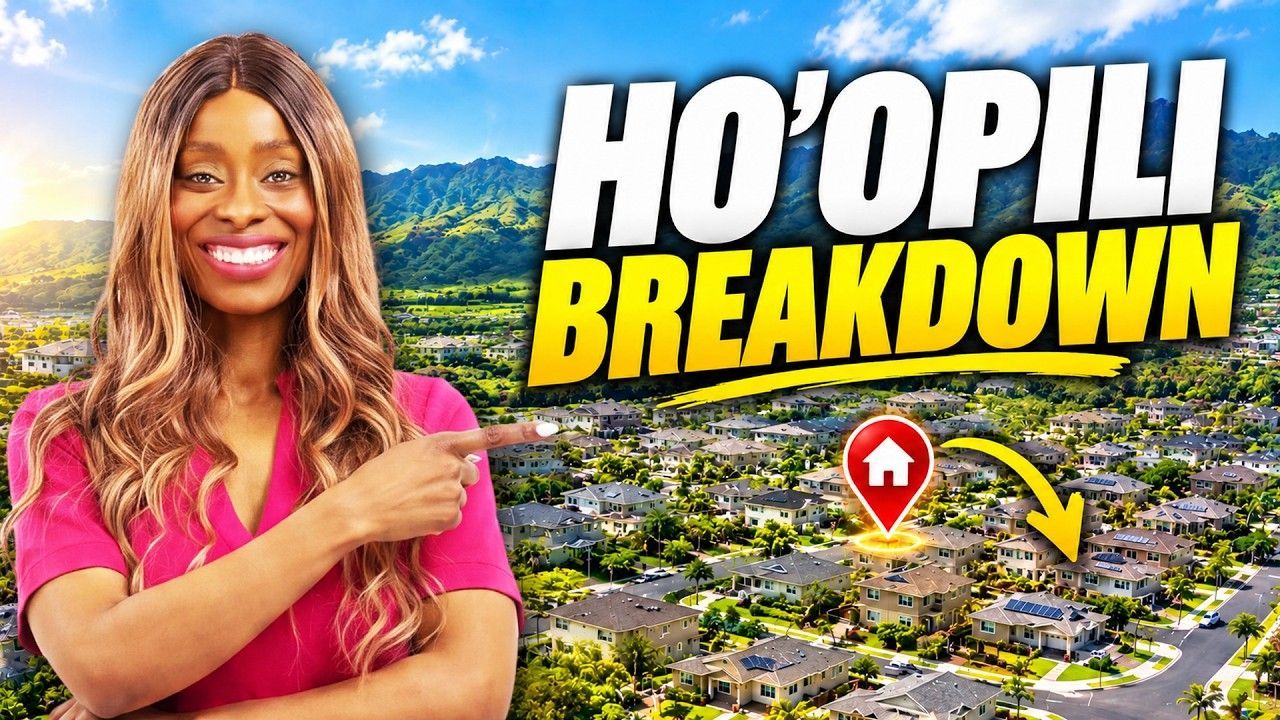
Hoʻopili is a 1,500-acre master-planned community built by D.R. Horton on former agricultural land at the mauka edge of the Ewa Plain, right where East Kapolei meets Waipahu and directly adjacent to the University of Hawaiʻi–West Oʻahu campus.
Lifestyle and Atmosphere
Hoʻopili is one of the newest and most ambitious developments on the island, planned to eventually include roughly 11,750 homes alongside three to four million square feet of commercial space, seven community and recreation centers, and more than 200 acres of urban farms and community gardens. It was also designed as West Oahu's first true transit-oriented development, meaning daily life here is built around walkability and rail access rather than the car-first layout of most Oahu suburbs.
Dining, Shopping, and Amenities
Hoʻopili sits less than two miles from Ka Makana Aliʻi, giving residents access to the region's biggest shopping and dining destination without a long drive, and the community itself includes its own SoHo Community Center with a pool and event spaces. Its biggest infrastructure advantage is genuinely unique on Oahu: Hoʻopili has three of its own Skyline rail stations, letting residents skip the worst of Ewa's H-1 traffic and ride straight toward Pearl Harbor, Aloha Stadium, and the airport.
Housing and Real Estate
Hoʻopili offers one of the broadest price ranges of any West Oahu community, from affordable-housing townhomes in the low $300,000s up to multigenerational single-family homes starting around $800,000, released in phases through a lottery system as new sections of the community open. The development is also planning five new schools as part of its long-term build-out, along with a Queen's Health Systems medical facility near its main entrance.
Who It's Best Suited For
Hoʻopili is a strong match for buyers who specifically want brand-new construction, rail access, and a community genuinely designed around reducing car dependence particularly first-time buyers chasing an affordable-housing lottery unit or anyone who values being able to walk to the train rather than fight West Oahu traffic every day.
Makakilo
Overview and Location
Makakilo sits on the hillside directly above Kapolei, climbing the foothills of the Waiʻanae mountain range to roughly 1,000 feet in elevation. The H-1 freeway physically separates it from Kapolei below, and it's generally divided into two sections: Makakilo Lower, with older custom homes on larger lots, and Makakilo Upper, with newer construction at higher, cooler elevations.
Lifestyle and Atmosphere
Makakilo's Hawaiian name, "observing eyes," fits the neighborhood perfectly, its elevated position delivers sweeping views over the Ewa Plain, Pearl Harbor, and the ocean beyond, along with noticeably cooler temperatures and steady tradewinds compared to Kapolei just below. It has a quieter, more suburban character than its bustling neighbor, with wide streets, sidewalks, and a genuinely peaceful, family-friendly reputation among residents.
Dining, Shopping, and Amenities
Because Makakilo sits directly above Kapolei, residents are only minutes from Ka Makana Aliʻi, Kapolei Commons, and the rest of the Second City's retail and dining scene, without the density of living in the flatlands. Locally, Makakilo Community Park anchors the neighborhood with basketball courts, playgrounds, and open green space, and hiking trails around Puʻu Makakilo give outdoor-minded residents a way to explore the hillside directly from home.
Housing and Real Estate
Makakilo's housing stock splits clearly by elevation: Lower Makakilo tends toward older, custom-built single-family homes with larger lots and no HOA fees, while Upper Makakilo offers newer subdivisions, townhomes, and gated communities, many built by D.R. Horton's Schuler division going back to the 1990s. It's consistently among the higher-income neighborhoods in West Oahu, and its elevated, view-oriented lots command a premium relative to comparable homes down in Kapolei or ʻEwa.
Who It's Best Suited For
Makakilo is a good fit for buyers who want the convenience of Kapolei's amenities without living directly in the middle of them especially those drawn to hillside views, cooler weather, and a quieter, more established residential feel, along with anyone willing to trade a slightly longer commute into town for space and scenery.
Choosing the Right West Oahu Neighborhood
Kapolei, ʻEwa Beach, Hoʻopili, and Makakilo each solve a slightly different problem for people moving to Oahu. Kapolei offers the most complete, self-sufficient urban experience; ʻEwa Beach delivers coastal, family-oriented master-planned living at a relative discount; Hoʻopili is the place to look for genuinely new construction and rail-connected convenience; and Makakilo trades a few extra minutes of commute for hillside views and a quieter pace.
What ties them together is what's made West Oahu one of the most active corners of the Hawaii real estate market: newer housing stock, more square footage per dollar, and a real, functioning city built specifically to give this side of the island the infrastructure it always deserved. For buyers priced out of Honolulu's South Shore or simply looking for more space and a slower pace without leaving the island's amenities behind, West Oahu is very much worth the drive.
Ready to See the Whole OAHU Island?
The Central Oahu is just one piece of the puzzle and picking a neighborhood without seeing how it stacks up against the rest of Oahu is how people end up with a rough commute or a budget that doesn't fit their lifestyle. Watch the full Oahu map walkthrough to see every region side by side: cost, commute times, schools, and hospitals so you can choose with the whole picture in front of you, not just one corner of it.
Teondra Mills | Pacific Luxe Group
If you are looking for a trusted advisor who delivers elevated service, understands Hawaiʻi real estate with deep Oʻahu expertise, and treats every client like ʻohana, you are in the right place.
Recent Posts